

Atmospheric water generators are equipment that recover some of the moisture from the air and treat the water obtained for the intended use. They offer a different supply option to evaluate: to produce near the point of consumption, without using water from a pipe, a well or the sea as a raw material. To choose them correctly, you have to relate three elements: water demand, local conditions and available energy.
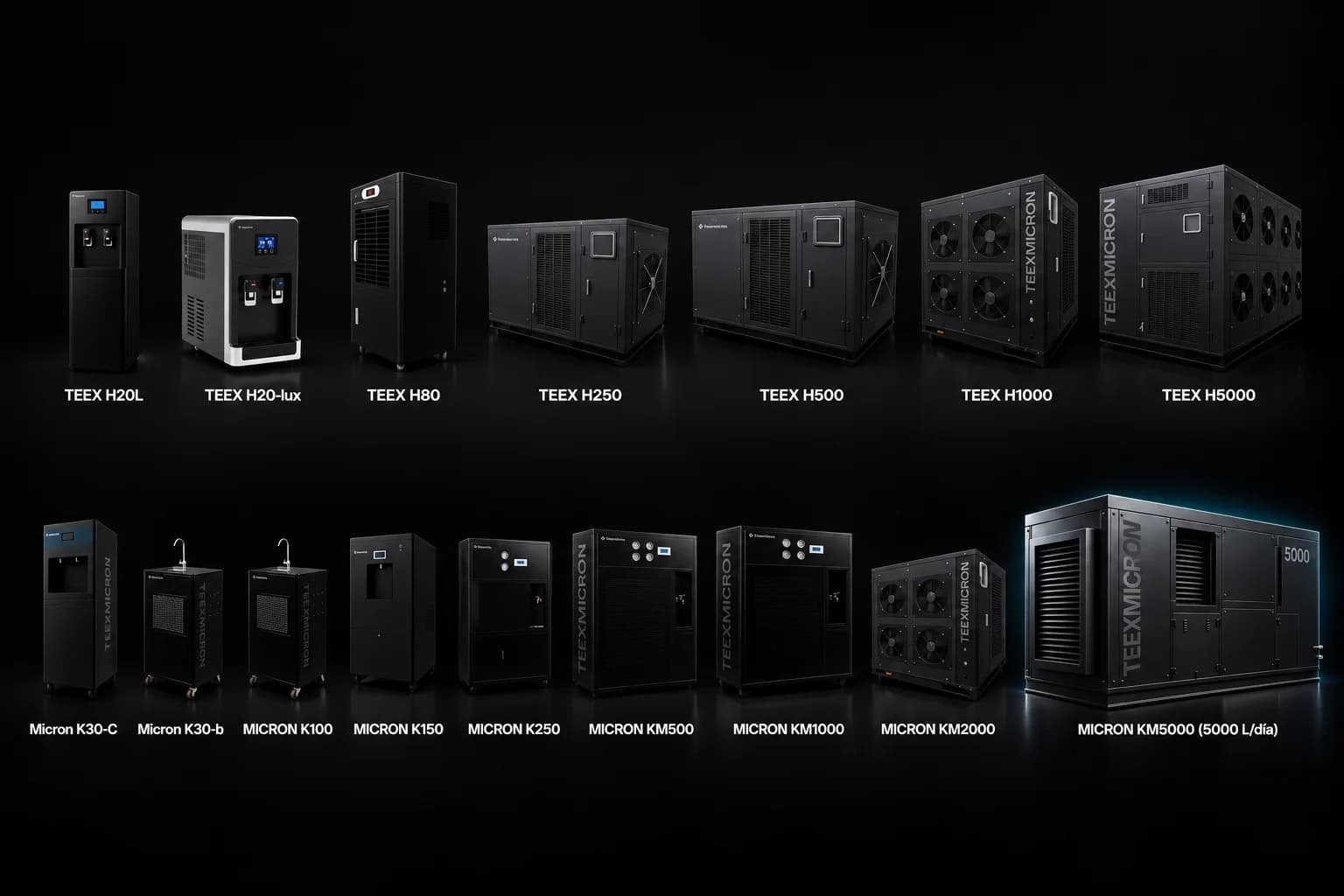
At Teexmicron you can consult a catalogue of atmospheric water equipment with different capacities. The goal is not to automatically choose the largest machine. It is to find a solution whose performance, installation and maintenance fit the project, whether you are looking for water for an office or study a business application.
What are atmospheric water generators
An atmospheric generator does not create water from nothing. The air contains water vapour and the equipment recovers a part through a technical process. In condensation systems, this process includes cooling the air so that part of the water vapour can move to a liquid state. Then the water treatment, storage and delivery elements are involved.
You can also find the English name atmospheric water generator and its acronyms, AWG. The Teexmicron documentation also uses GAAP. What matters when comparing proposals is not the acronym, but what system is offered, under what conditions has been evaluated and for what use the water is delivered.
It is appropriate to distinguish three figures that are sometimes mixed: the litres that the equipment can produce during a reference day, the capacity of its tank and the volume that an installation needs daily. Each figure answers a different question. A large tank does not in itself increase the production of the generator.
How an atmospheric water generator works
The Teexmicron atmospheric generation technology is based on air capture, condensation and treatment. The specific configuration must be checked in the documentation of the selected model; not all the options described for a complete system have to be included in each machine.
Air capture and circulation
The air must reach the equipment in conditions compatible with its design. The entrance, filters and ventilation space are part of the installation, not accessory details. Placing a machine in an inadequate enclosure can prevent it from working under the intended conditions.
The precise installation location therefore needs to be assessed. A ventilated courtyard, a technical room and an industrial building with dust or emissions are not equivalent situations. The project must define where the air comes from, how it circulates and what service distances the manufacturer requires.
Water condensation and collection
The cooling allows to reach conditions in which part of the water vapour is condensed. The National Weather Service explains the relationship between dew point and moisture: the temperature and water vapour content should be interpreted together. This relationship helps to understand why two locations with the same percentage of moisture can offer different results.
The condensed water is collected and led to the next stages. The circuit, its materials and its cleaning matter as much as the condensation capacity. Obtaining liquid is a part of the process; having an adequate supply for end-use requires completing and maintaining the system.
Treatment and supply
Teexmicron's technological information describes different stages of filtration and disinfection, as well as mineral adjustment and storage options. When requesting a proposal, identify which stages are included in the selected equipment and which belong to the supporting installation.
For human consumption, quality must be verified by the relevant documentation and controls. The World Health Organization water quality guides recommend risk management from collection to consumer. It is not enough for the water to look good or come from the air.
How much water they can produce
The nominal capacity allows to order the catalogue, but does not amount to a guaranteed production in every city and season. Before using it to size a supply, you need to know the reference conditions and the expected production at the installation site.
These are five real references from the TEEX range. The links lead to their published product pages, where you can expand the information and request a specific proposal.
ModelPublished daily productionApplications described on the product pageTEEX H20L20 litresKitchen, office and housingTEEX H8080 litresOffices, clinics and small businessesTEEX H250250 litresMedium-sized businesses, dining rooms and common areasTEEX H10001,000 litresFarms, industries and tourist complexesTEEX H50005,000 litresIndustrial facilities and higher demand projectsThis selection does not replace the full catalogue or prove that all applications are viable in all locations. It serves to start comparing project sizes. The final choice needs an assessment that relates capacity, climate, water use and operating conditions.
Humidity and temperature: the data that change the choice
A one-day weather consultation does not describe the behavior of the whole year. To assess a generator it is interesting to see how temperature and humidity match during the hours in which it is intended to be produced, and how this combination between seasons changes.
This is especially important in facilities with seasonal occupation. An accommodation may need more water at a given time; a productive activity may concentrate its demand on specific shifts. The study should compare these periods with the conditions available, rather than using only an annual average.
In our guide to humidity, temperature and atmospheric water production We explain what information should be gathered. The precise location, climate history and installation space conditions allow you to ask useful questions before selecting a model.
Applications in housing and small business
In a home, the first step is to define the use: drinking water, food preparation or other specific need. This consumption should not be confused with all water used in showers, cleaning, irrigation and other domestic activities. They're different demand scales.
For a private workspace or an office also matter the occupation, the opening days and the way the water is dispensed. The number of users helps but does not replace an estimate of consumption. To review current purchases of bottles or drums can provide an initial reference, provided the uses included are identified.
The small models of the catalogue allow you to explore these applications. The decision requires checking location, electrical supply, maintenance and comfort of use. A properly sized machine must solve a daily need without introducing an operation that the user cannot support.
Applications in industrial companies and facilities
In a company, it is appropriate to separate water for people from water used in processes. A dining room, a rest area and an industrial line may need different qualities, times and volumes. They should not be grouped under a single figure without describing each service.
Atmospheric water production can be studied as a main source, complement or support. These functions lead to different designs. To complement an existing supply, it can be sufficient to cover a specific part of the demand; for an essential service, it is also necessary to consider reserves, failures and supply alternatives.
When the range exceeds the choice of a machine, it is useful to review our solutions for engineering for water systems. The complete project relates production, storage, energy and distribution, and allows to define the responsibilities of each party before installing.
Electric consumption of atmospheric water generators
The equipment needs energy to work. Electrical values of 0.47, 1.25, 2.45, 8.7 and 46 kW are published in the files of the five above models, respectively. These values are expressed in power; they are not, on their own, a daily energy bill or a consumption per litre.
In order to assess the operation, the kilowatt-hours consumed during a period and the litres produced during the same period are needed. The relationship between the two dimensions allows to calculate the specific consumption. The project's electricity tariff can then be applied, always differentiating electricity and total cost of supply.
The guide to electrical consumption of an atmospheric water generator develops this comparison. Avoid choosing for the lowest number of kW without considering how much water you get and under what conditions. A lower power does not show, in isolation, lower consumption per litre.
Installation: space, ventilation and access
Before confirming the order, the access of the equipment, the support area, air circulation and electrical availability should be reviewed. It is also appropriate to reserve space for inspections, replacement of consumables and possible interventions. The installation does not end when the machine physically fits into a space.
In business projects, the site should be coordinated with the usual activity. It is necessary to check the required acoustic conditions, the proximity to occupied areas, the protection against the environment and the connections that the whole may require. These aspects are resolved with the installation documentation, not by assumptions about the size of the equipment.
The paragraph from purchase to installation explains the Teexmicron process. Before committing to a contract, establish which work the proposal includes, who prepares the site and who commissions the installation.
Storage: production and consumption do not always coincide
The demand can be concentrated in a limited number of hours while the equipment produces for a longer period. Storage allows to study this difference, but it must be dimensioned with criterion. A tank provides a reserve, not an automatic solution for continuous insufficient production.
To choose it you have to know its useful volume, consumption periods, storage conditions and access for cleaning. It should also be considered how water will reach the user: direct supply, consumption points or internal network, according to the project.
The solutions atmospheric water tanks are part of that analysis. The size and configuration must be justified next to the generator, avoiding buying both items separately without checking their compatibility.
Solar energy and autonomy
A generator can be integrated into an installation using solar energy when the electrical system is properly dimensioned. This requires linking generation, equipment demand, times and possible support. Having available panels does not show sufficient power and energy for any model.
In addition, the independence of the water network and the independence of the electricity network are different objectives. A project can get water from the air and continue to be connected to conventional electricity. Another can incorporate energy storage or a hybrid system, with its corresponding costs and conditions.
In the Teexmicron energy solutions you can study that integration. The evaluation should include investment, maintenance and replacements, without confusing a reduction in electricity purchased with water produced at no cost.
Maintenance and continuity of service
Filters, treatment elements and the water circuit require model-and-use planning. The frequencies should be obtained from the manual and operating conditions; there is no universal schedule that can be applied to any equipment without checking its requirements.
In an undertaking, it is appropriate to assign a person responsible, record the interventions and provide for the necessary consumables. It is also important to know which tasks the user can perform and which require technical assistance. A good plan prevents maintenance from being dependent on remembering a date or detecting an incidence when it already affects the service.
See Teexmicron spare parts and consumables when preparing the purchase. The availability, compatibility and application procedure are part of the decision, especially in locations where receiving a spare can condition continuity.
How to compare a generator with other forms of supply
The comparison should be made for the same use and level of service. The cost of drinking water distributed in containers is not directly comparable to that of network water for all uses of a building. Before calculating savings, it is necessary to identify which supply is actually replaced.
It is also appropriate to include installation, electricity, maintenance, treatment, storage and backup. If an alternative requires transport or handling, these costs should be collected in a verifiable manner. If the existing network already provides an adequate service, it must enter the comparison without assuming that a different technology will always be more economical.
The useful result is not a general statement of profitability. It is a concrete answer: how much water is expected to be provided, at what cost, at what quality conditions and what problems the installation helps to solve.
Frequently asked questions about atmospheric water generators
Do they work the same all year?
This should not be assumed. Production should be assessed with the environmental and operational conditions of each period. A nominal figure allows to identify the model, but the sizing needs more detailed information and, when the supply is critical, a reserve plan.
Is water from the air automatically safe to drink?
No. Its destination for human consumption requires appropriate treatment, conservation and verification. The system documentation and the applicable controls are those that allow the assessment of quality, not atmospheric origin alone.
Can a generator be used without water connection?
Atmospheric capture allows to study a supply without using the water network as a source. However, the project must solve energy, treatment, maintenance and distribution. The absence of a water connection does not eliminate these needs.
How do I know what model I need?
Gather the location, water use, daily consumption, hours and site characteristics. With these data you can compare the catalogue and request an evaluation. Choosing solely by the number of litres printed on the product page leaves important factors out of the decision.
Check your project with Teexmicron
The best starting point is a well-defined need. Indicate where you want to install the equipment, which water you need to replace or supplement and how consumption is distributed. Add the electrical information and space limitations you already know.
Through Teexmicron support and counselling centre you can request information about the models and propose your project. In this way you can compare a specific proposal, with its scope and conditions, rather than making the decision only for a nominal capacity.