

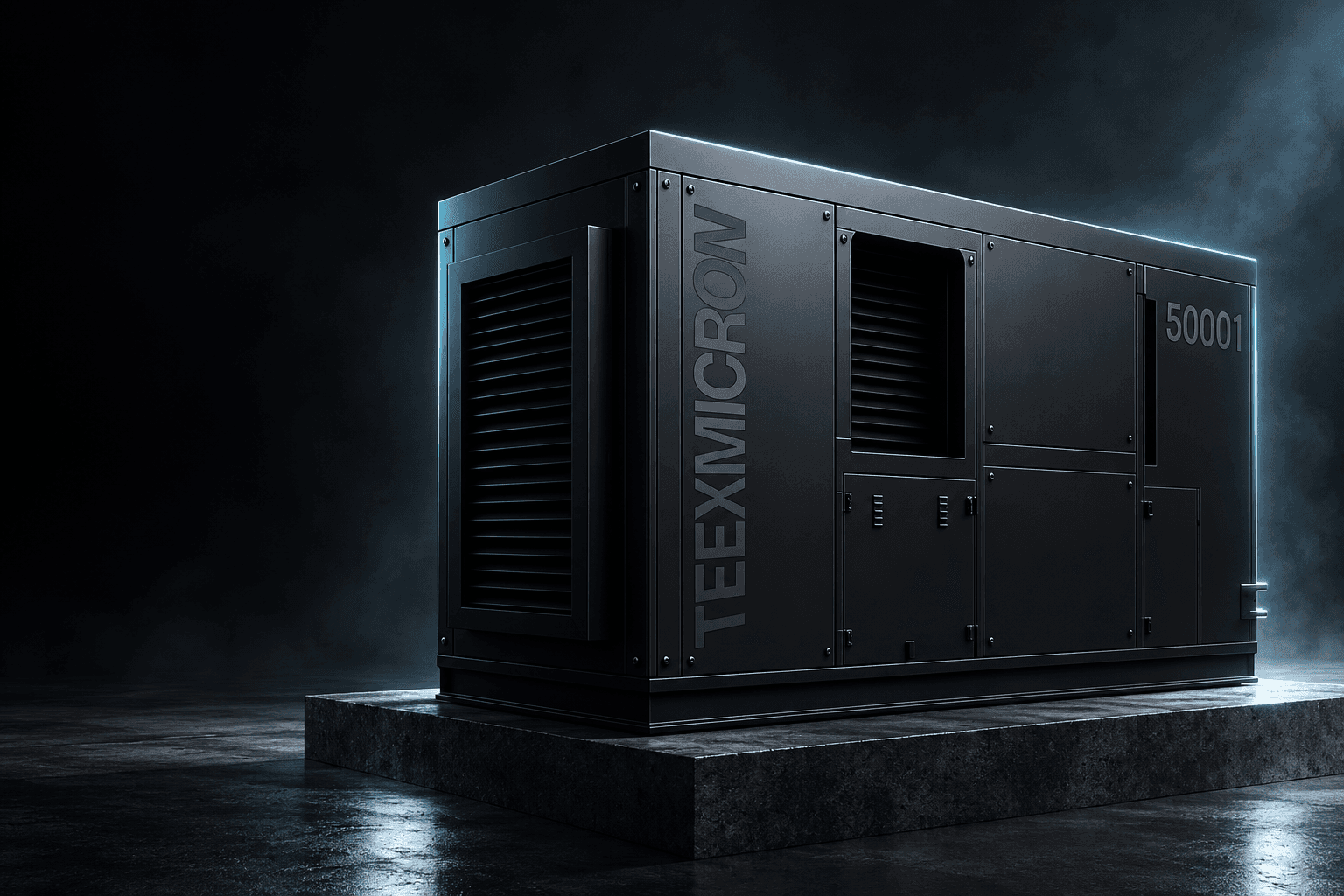
An atmospheric water generator extracts water from moisture in the air. To assess whether it is suitable for a home, a business or an industrial project, look beyond its rated capacity: temperature, available humidity, energy consumption and maintenance all affect the result.
This guide explains the process and the selection criteria. If you are already looking for a specific solution, explore Teexmicron atmospheric water generators and request an assessment for your installation site.
What is atmospheric water?
It is water recovered from water vapour in the air. A generator does not create water out of nothing: it captures that moisture through a technical process. Several collection technologies exist; in condensation-based equipment, air is cooled so that some of its water vapour turns into liquid.
This approach can be assessed as an alternative or a supplement to the available water supply. Its suitability depends on the context and water requirements, rather than simply on whether an area has supply problems.
How an atmospheric water generator works
- Air intake and filtration. The equipment draws in ambient air and directs it to its collection system.
- Condensation. In a refrigeration system, a cold surface allows some of the moisture in the air to be collected.
- Water treatment. The equipment incorporates filtration and treatment processes suited to its intended application.
- Storage and supply. Water is stored and distributed according to the configuration and conditions of use.
Collection and treatment are separate stages. For drinking-water use, check the equipment documentation, quality controls and planned maintenance. Learn about our systems in the atmospheric water generation technology section.
Humidity and temperature: why they matter
The amount of water that can be recovered varies with environmental conditions. A daily output figure in litres must therefore be considered alongside the temperature and humidity at which it was obtained. Two locations in the same country may offer different operating conditions.
When assessing an installation in Spain or Latin America, analyse the climate at the specific location throughout the year. A useful estimate compares expected output with daily demand and accounts for less favourable periods.
What to check when choosing equipment
- Daily demand and uses. Define how much water you need and which activities it will serve.
- Output under known conditions. Request the model's performance data and test conditions.
- Available energy. Check the electricity supply, power requirements, energy consumption and operating hours.
- Space and installation. Check ventilation, access and site requirements.
- Servicing and maintenance. Consider consumables, cleaning, inspections and technical support.
The Teexmicron equipment catalogue is a starting point for comparing models and specifications. To understand the project stages, see the purchase and installation guide. If you need extra storage, explore the water tank options.
Purchase price and cost per litre are different measures
The initial budget and running costs answer different questions. Investment may include equipment, installation and auxiliary components. Operating costs need to account for electricity, actual output, consumables and maintenance.
It is also useful to distinguish power, expressed in kW, from energy consumed, expressed in kWh. To compare options, request calculations with explicit assumptions and equivalent units. If the project includes renewable generation, our energy solutions section provides a starting point for assessing its integration.
Applications: homes, businesses and larger projects
An office, accommodation facility and industrial installation have different needs. Beyond water volume, operating hours, storage, required supply continuity and maintenance capacity also vary.
Where the water supply forms part of a complex installation, preparing a water and energy balance is useful. Our large projects and engineering areas can help you scope that study.
Frequently asked questions
Does it produce the same amount of water every day?
Do not assume constant daily output. Environmental conditions and equipment operation affect the result; the stated capacity must be accompanied by its reference conditions.
Can it run on solar energy?
This is an option that requires appropriate system sizing. Check electricity demand, generation hours, energy storage where needed and the required continuity of supply.
How do I know which model I need?
Provide the location, estimated daily consumption, intended use and available energy supply. These details allow feasibility to be assessed and models to be compared against specific criteria.
The next step for your project
Start by comparing the available equipment and gathering information about your installation. For questions or an assessment, contact the Teexmicron team. This will help you evaluate a solution suited to your consumption and site conditions.
Technical references
For general background on recovering water from air and the influence of environmental conditions, see the US Department of Energy: alternative water sources and EPA: Atmospheric Water Generation Technology. These references describe the technology in general; they do not certify any particular Teexmicron model.